
Applying for a job can be an exciting but sometimes stressful experience. You prepare your resume, look for suitable vacancies, and get ready to present your skills to an employer. But what happens when the employer asks you to submit a handwritten job application letter?
In today's digital world, most job applications are submitted online. However, some employers, schools, colleges, government offices, and local businesses may still request a handwritten application. If you are a fresher or have never written a formal application letter before, you may not know where to begin.
You might wonder what to write, how to address the employer, what format to follow, or how to make your letter look neat and professional.
The good news is that writing a job application letter does not have to be difficult. With the correct format, clear language, and a little preparation, you can create a letter that presents your qualifications and interest in the position.
In this guide, we will explain how to write a handwritten job application letter, share a sample format, discuss common mistakes, and introduce a free online tool that can help you prepare your letter.
What Is a Handwritten Job Application Letter?
A handwritten job application letter is a formal letter written by a person who wants to apply for a job. It introduces the candidate to the employer, mentions the position they are interested in, and briefly explains their qualifications, experience, and suitability for the role.
Unlike a typical online application, a handwritten application is prepared on paper rather than submitted only as typed text.
Some employers request handwritten letters because they follow a traditional application process or want candidates to submit physical documents. You may come across this requirement when applying for teaching positions, certain government or public-sector roles, local business jobs, or positions advertised through walk-in interviews.
However, not every employer requires a handwritten letter. Always read the job advertisement carefully and follow the instructions provided.
Why Do Some Employers Still Ask for Handwritten Applications?
Although digital recruitment is common, handwritten applications remain relevant in certain situations.
- A formal application process - Some organisations follow a traditional recruitment process in which candidates submit a written application along with their resume and certificates.
- Government and educational positions - Certain recruitment notices, schools, colleges, or institutions may request a handwritten application or a specific letter format. Requirements vary, so applicants should always check the official notice.
- Local businesses - Small businesses sometimes prefer a physical application that candidates can submit directly to the office or manager.
- Walk-in interviews - An employer may ask candidates to bring a written application when attending an interview. Preparing the letter beforehand can help you avoid last-minute confusion. The important point is that a handwritten application should follow the employer's instructions. If the notice specifically requires a letter written in your own handwriting, you should write it yourself.
What Is the Correct Format for a Job Application Letter?
A professional job application letter follows a simple structure. Keeping the information in the correct order makes the letter easier to read.
1. Write Your Contact Details
Start with your full name, address, phone number, and email address. Use accurate contact information so the employer can reach you if needed.
2. Add the Date
Write the date on which you are preparing the application. This helps identify when the letter was submitted.
3. Address the Employer
Mention the recipient's designation, organisation name, and address where appropriate.
For example:
The HR Manager
ABC Private Limited
New Delhi
If you are applying to a school, you might address the letter to the Principal. If the employer has provided a specific contact name, use that name.
4. Add a Clear Subject Line
The subject should explain why you are writing.
For example:
Subject: Application for the Post of Office Assistant
A clear subject line helps the reader understand the purpose of your letter immediately.
5. Use a Formal Greeting
You can use a greeting such as "Dear Sir/Madam" if you do not know the recipient's name. If you know the person's name, address them appropriately.
6. Write the Main Body
The main body usually contains three or four short paragraphs.
- State the position you are applying for and where you learned about the vacancy.
- Explain your qualifications, experience, and relevant skills.
- Mention one or two reasons you may be suitable for the position.
- Politely request an opportunity to attend an interview.
Avoid writing a very long story. The employer needs clear and relevant information.
7. Close the Letter Properly
Use a formal closing such as "Yours sincerely" or "Yours faithfully", depending on how you addressed the recipient. Leave space for your signature when required, followed by your full name.
8. Mention Enclosures
If you are submitting a resume, certificates, or other documents, mention them at the end of the letter when appropriate.
Sample Handwritten Job Application Letter for a Fresher
If you have recently completed your studies and are applying for your first job, you can use the following sample as a starting point.
Your Name
Your Address
Your Phone Number
Your Email Address
Date: [Date]
To,
The HR Manager
ABC Private Limited
New Delhi
Subject: Application for the Post of Office Assistant
Dear Sir/Madam,
I am writing to apply for the post of Office Assistant in your organisation. I learned about this opportunity through [mention the source of the vacancy].
I have recently completed my [qualification] from [institution name]. During my studies, I developed basic computer, communication, and organisational skills. I am willing to learn new things and work sincerely to complete the responsibilities assigned to me.
I believe this opportunity would allow me to develop my skills and contribute positively to your organisation. I would be grateful if you could consider my application and give me an opportunity to attend an interview.
Thank you for your time and consideration.
Yours faithfully,
[Your Name]
Enclosures: Resume and relevant certificates, if required.
Important: Replace every placeholder with your actual details. Do not include qualifications, skills, or experience that you do not have.
How to Write a Job Application Letter When You Have No Experience
Many freshers worry that they have nothing useful to write because they have not worked in a full-time job before. This is a common concern, but a lack of work experience does not mean you cannot write a good application.
Focus on what you can honestly offer.
Mention your education. Include your qualification, relevant subjects, and any useful training you have completed.
Talk about projects. If you completed an academic project, explain briefly what you did and what you learned.
Highlight relevant skills. These may include computer knowledge, communication, teamwork, problem-solving, or other skills relevant to the position.
Show willingness to learn. Employers hiring entry-level candidates may value a positive attitude, reliability, and a genuine interest in the role.
Keep the letter specific. Avoid sending the same generic application for every position. Mention the actual job title and, where possible, one reason you are interested in that organisation.
A fresher's application does not need to sound complicated. Clear, honest writing is often more useful than using difficult words.
How to Make Your Handwritten Application Look Professional
The presentation of your letter matters because it affects how easily someone can read it. Follow these practical tips when preparing your application.
Use neat and readable handwriting. Write at a comfortable pace and avoid squeezing too much text onto the page.
Keep the letter short. In most cases, one page is sufficient. Focus on information related to the job.
Use proper spacing. Leave suitable space between paragraphs and around the edges of the page.
Choose simple language. Formal does not mean complicated. Use polite, direct sentences.
Check spelling and grammar. Read the entire letter before submitting it. A small mistake can sometimes change the meaning of a sentence.
Avoid unnecessary information. Personal details that do not help explain your suitability for the position usually do not need to be included.
Follow the requested format. If the employer has supplied a specific format or asked for a particular type of paper, follow those instructions.
Keep your information accurate. Make sure your name, phone number, qualifications, and other details are correct.
These small steps can help you prepare a clear and organised application.
Common Mistakes to Avoid
Even a simple application letter can become less effective if it contains avoidable errors.
Using the Wrong Job Title
Check the vacancy before writing your subject line. Applying for the wrong position can create confusion.
Copying a Sample Without Editing It
Sample letters are useful for understanding the format, but they should not be submitted with someone else's name, company details, or qualifications.
Writing Too Much
An application letter is an introduction, not your complete career history. Keep your main points relevant to the job.
Using Informal Language
Avoid slang, casual greetings, or messages that sound like a text to a friend. Maintain a polite and professional tone.
Forgetting to Sign the Letter
If the employer expects a signed physical letter, remember to sign it before submission.
Ignoring the Employer's Instructions
Some organisations require original handwriting, a specific application form, or particular supporting documents. A neat letter cannot replace compliance with those requirements.
Prepare Your Letter Online with the Free LeaveTrackr Tool
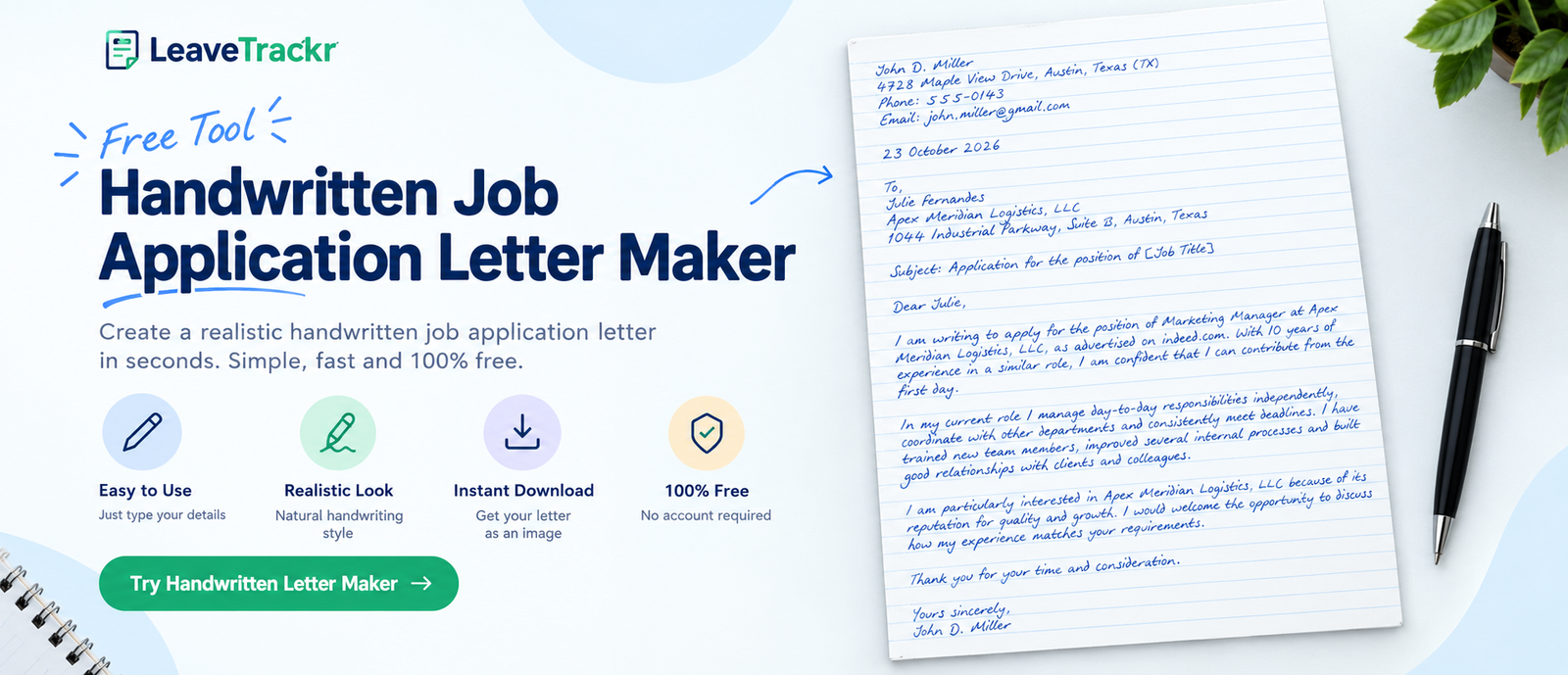
Writing a formal letter from scratch can take time, especially when you are unsure about the format. To make the process easier, LeaveTrackr offers a free Handwritten Job Application Letter Maker.
You can open the tool here:
https://leavetrackr.com/tools/handwritten-job-application-letter/
The tool is designed to help job seekers prepare a job application letter using ready-made templates and handwriting styles.
Here is how it works.
Step 1: Choose a Suitable Template
Select a template based on your situation. Available options include applications for freshers, experienced professionals, internships, teachers, office roles, government positions, and other common job categories.
Step 2: Add Your Details
Edit the sample letter and replace the bracketed placeholders with your own information. Add the correct job title, employer details, qualifications, and other relevant information.
Step 3: Select a Handwriting Style
Choose from the available handwriting fonts. You can also adjust the appearance of the text, including its size and colour.
Step 4: Choose Your Paper
Select plain paper, lined paper, or lined paper with a margin, depending on your preference and the employer's instructions.
Step 5: Review Your Letter
Check the content carefully. Make sure no placeholders remain and that all information is accurate. Adjust the spacing and layout if necessary so the letter fits neatly on the page.
Step 6: Download Your Letter
Download your prepared letter as a PDF, Word document, or image. You can then print it or use the file in the way permitted by the employer.
The tool is free to use, requires no sign-up, and does not add a watermark to your downloaded letter.
Can You Use Your Own Handwriting?
The LeaveTrackr tool also offers an option to create a handwriting style from your own writing. You can use the handwriting sheet provided by the tool, fill it in with a pen, and upload a photo to generate a font based on your letter shapes.
This can help you create a more personal appearance when the tool is appropriate for your intended use.
However, remember that using a digital tool to create a handwriting-style document is not the same as physically writing the letter yourself. If an employer specifically requires the application to be written by hand, prepare the final letter in your own handwriting.
The safest approach is always to follow the exact instructions in the job advertisement.
Should You Download a PDF, Word File, or Image?
The right format depends on how you need to use the letter.
PDF: A useful choice when you want a print-ready document that preserves the page layout.
Word document: Helpful when you need a document file for a process that accepts Word files.
Image: Useful in situations where an image is specifically accepted or required.
Before sending anything, confirm which file formats the employer accepts. If you are submitting a physical application, print the letter as instructed and sign it if required.
Final Thoughts
A handwritten job application letter does not have to be difficult. Once you understand the correct format, you can introduce yourself clearly, explain your interest in the position, and present your qualifications in an organised way.
If you are unsure how to begin, use a sample letter as a guide, personalise it with accurate information, and check the employer's instructions before submitting it.
The free LeaveTrackr Handwritten Job Application Letter Maker can help you prepare the wording and layout more easily, with templates for different job types and options to download your letter in several formats.
Ready to prepare your application?
Try the free tool here:
https://leavetrackr.com/tools/handwritten-job-application-letter/
Take a few minutes to prepare your details, review your letter carefully, and make sure your application follows the employer's requirements. A clear and well-prepared application is a useful step in your job search.